 Renew Before It Lapses
Redeem
Redemption and release: what happens after deletion
Last reviewed
The short version
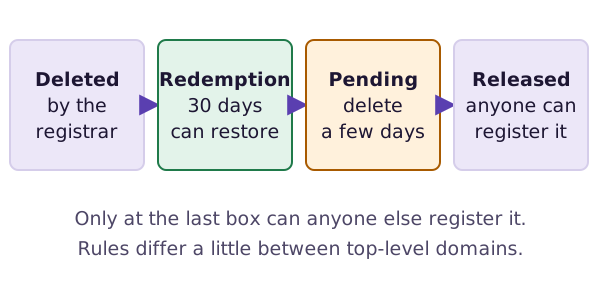
- After a registrar deletes an expired name, most generic names get a 30-day redemption period.
- In those 30 days only your registrar can restore the name for you, and a fee may apply.
- Then comes a short wait of a few days.
- After that, the name is released. Anyone can register it.
Deletion is not the end, at first
Say the date passed and nobody renewed. At some point, the registrar deletes the name. That doesn't make it free for everyone straight away.
For generic names, ICANN's policy gives a redemption grace period of 30 days after deletion. In those days, the registrar that deleted the name can restore it, if you ask.[1] Special "sponsored" generic names are an exception.[1]
During the 30 days
Two things stop working while the name is in redemption.
- The name is switched off in the DNS, so the site won't load.[1]
- You can't transfer the name to another registrar.[1]
The way back is to ask your registrar. Once any problems are sorted out and the right fee is paid, the registrar should restore the name for you.[2]
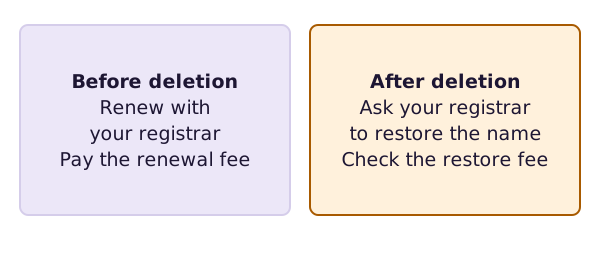
What does it cost? That's up to the registrar. But it must show its restore fees, and any different fee for renewing after expiry, when you register.[1] Read that page before you need it.
The words you'll see in a lookup
In a lookup of the name, three status words can show up. We cover lookups on a later page.
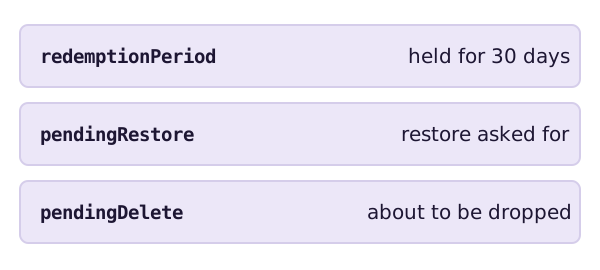
- redemptionPeriod: the registrar has asked the registry to delete the name. It's held for 30 days.[2]
- pendingRestore: the registrar has asked the registry to restore a name that was in redemption.[2]
- pendingDelete: the name wasn't restored within the 30 days.[2]
After the 30 days
When the 30 days end, the name stays in a "pending delete" stage for a few more days. ICANN's page gives a number. Five calendar days after redemption ends, the name is purged from the registry's list. Then it becomes available for registration.[2]
From that point, the name can be registered again under the registry's own rules.[2] Anyone may try. You'd have to compete like any other buyer.
What to do if it's already deleted
- Act on day one. The 30 days run out quickly.
- Contact your registrar, not a random site that claims to recover names.
- Ask for the restore fee before you agree.
What next
Maybe you don't want to lose a name, but you're not happy with your registrar. The next page shows how to move a name in good time.
Sources
- Expired Registration Recovery Policy, ICANN (accessed 2026-10-26)
- EPP Status Codes | What Do They Mean, and Why Should I Know?, ICANN (accessed 2026-10-26)