 Renew Before It Lapses
Register
What you own when you register a domain
Last reviewed
The short version
- Registering a domain doesn't make you its legal owner.
- It gives you the sole right to use the name for a set time.
- The longest time is 10 years in one go.
- You're called the registrant. You have jobs to do, and renewing is the big one.
"Owner" is the everyday word
Most people say they "own" their domain. That's fine in conversation. But the exact wording is different.
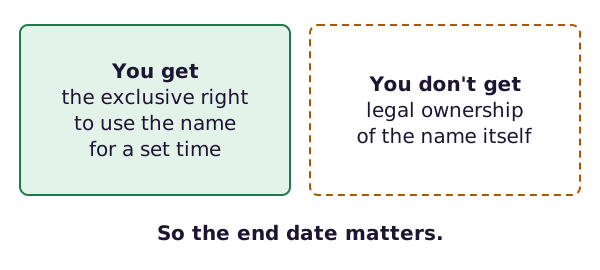
Registering a name with a registrar doesn't give you legal ownership of it. It gives you an exclusive right to use it for a set length of time.[1]
The proper word for you is registrant, or "domain holder".[1] The registrant is the person or group the name is registered to.
A registrar is the company you register through. It manages the reservation of domain names.[2]
What happens when you register
The steps are short.
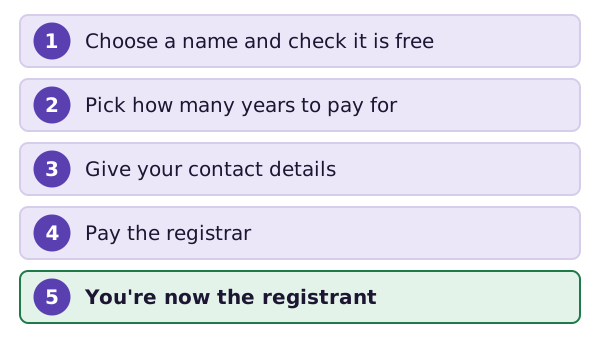
The exact screens differ from one registrar to the next. The idea is the same. You pick a name, say how long you want it for, give your details and pay.
How long it lasts
You don't pick a name for ever. You pick a term, which is the number of years you've paid for.
The longest term for a generic name such as .com is 10 years.[2]
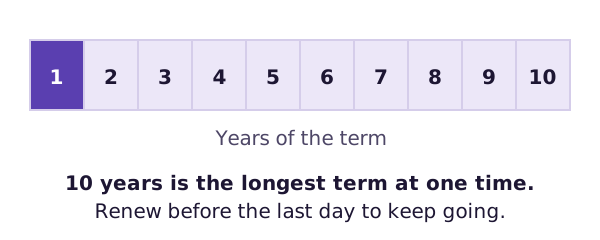
Some registrars say they offer up to 100 years. Look closely. In that case the registrar renews the name for you every 10 years.[2] The 10-year limit hasn't moved.
When the term ends, the right to use the name ends too, unless you renew. The next pages show how.
Your jobs as registrant
ICANN publishes a list of what a registrant must do. Two of the items matter most here.
- You take sole responsibility for the registration and use of your domain name.[3]
- You must give accurate details for public directories such as WHOIS, and update them quickly when they change.[3]
WHOIS is a public lookup of who registered a domain. We cover it on the lookup page.
What next
The details you give now are the details that matter later. So the next page looks at whose name should go on a registration, and why a business should care.
Sources
- Domain name, Wikipedia (accessed 2026-10-26)
- Domain name registrar, Wikipedia (accessed 2026-10-26)
- Registrants' Benefits and Responsibilities, ICANN (accessed 2026-10-26)